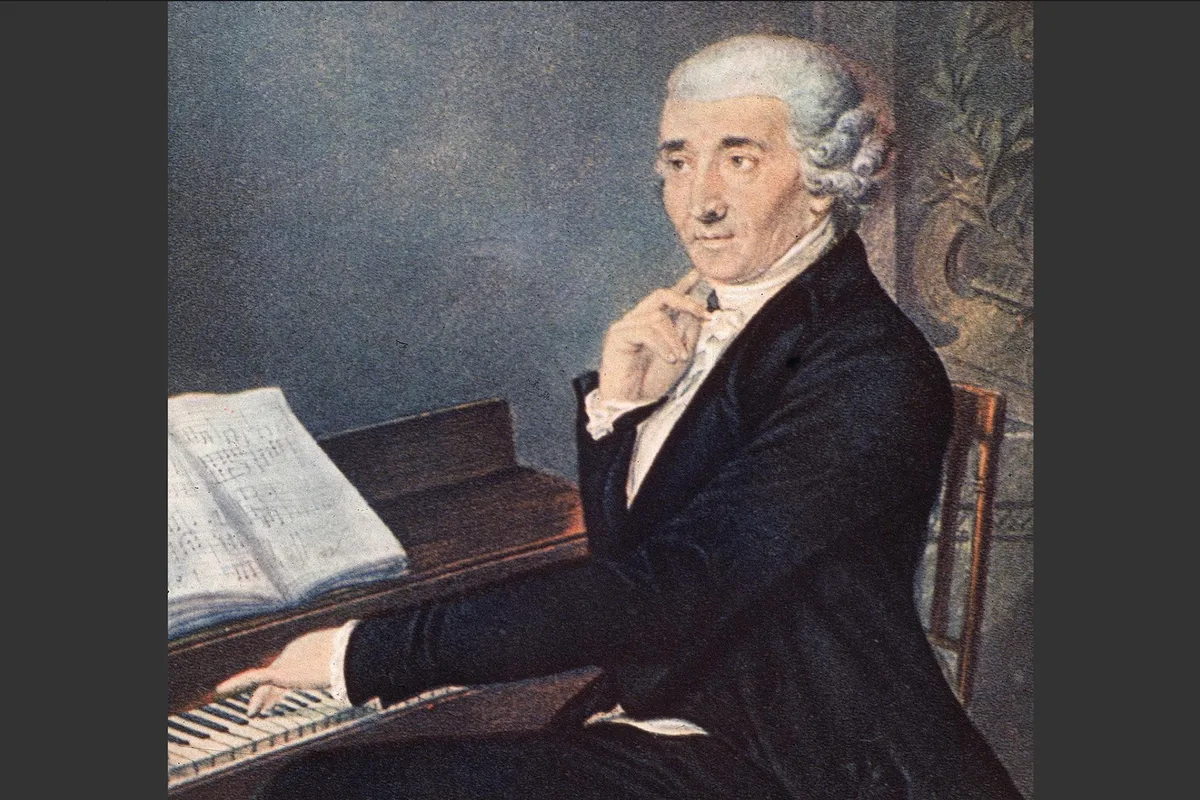
The moving experience of singing Haydn's Creation
It’s 17 years ago now, yet the memory is etched as if yesterday. The great Australian conductor Charles Mackerras was obviously ailing. At the age of 83 he was undergoing chemotherapy each morning yet determined to fulfil one more engagement that clearly meant a lot to him. He had agreed to conduct Haydn’s oratorio The Creation, not with a top professional team but with the mixture of music students and enthusiastic amateurs that used to turn up each July and August at the Dartington International Summer School in Devon.
As a boy treble, 45 years earlier, I had the thrill of singing in the children’s choir on a Mendelssohn recording that Mackerras had made. I had revered him ever since – for his passion, incomparable knowledge and scholarship, down-to-earth humour, and most of all for the wit and verve of his music making. So, I resolved to join the amateur chorus for this Creation in order to sing under his baton one last time.
It was one of the better decisions of my life. Mackerras must have felt terrible, yet he outwardly showed not a sign of his illness. But nor did he take any prisoners in rehearsal. He expected us all to rise to the considerable challenge of this life-enhancing oratorio.
The result was overwhelming. Yes, there were probably rough edges, but sometimes the fervour of a performance and the sense of being part of a unique occasion far transcend such pedantic considerations. As far as I was concerned (and I think Mackerras too) that was the case here.
Haydn celebrated and preserved the old traditions with good humour
But on that memorable night we weren’t just celebrating one great man and his achievement. Haydn was also getting older and frailer in 1798 when he wrote The Creation. He must also have felt that the world in which he grew up and made his career – a hierarchical world of rank and privilege that nevertheless provided musicians with steady employment – was fast disappearing.
At the same time, industrialisation was beginning to change the rural landscape he had known since he was a child. And even his Catholic faith was under attack in this new ‘age of reason’, in which clever young men sought to dispel old superstitions with a dose of unsentimental rationality.
Yet in these two magnificent late oratorios – The Creation and The Seasons – it’s as if Haydn is attempting not just to celebrate all those old ways and beliefs but also to preserve them by painting them into his music. And into such exuberant music too. His massive symphonic output is a marvel. But I would argue that his choral works are no less imbued with his distinctive genius.
'Undiluted joy, largely free of self-doubt and introspection...'
As a singer in a reasonably proficient choir, you get to learn, understand and perform many of the most profound masterpieces in music history. When measuring choral Haydn against choral Bach, Handel, Beethoven, Brahms, Elgar or Verdi it’s easy to dismiss him as somehow simplistic or lightweight. You certainly don’t get much sense in Haydn’s choral music of anguish, turbulence or doubt – if, indeed, that is what you are looking for.
But it’s this very spiritual certainty that makes singing his music so life-enhancing. It’s a stream of pure, undiluted joy, largely free of self-doubt and introspection, revelling in depicting an almost childlike vision of an idealised world, whether it’s the ‘Book of Genesis’ in The Creation or 18th-century agrarian life in The Seasons.
The Harmoniemesse... his final great work
The dramatic, sometimes even comic way that Haydn uses different instruments to depict animals, the cosmos and nature in The Creation is rightly famed. But for me even that mastery is eclipsed by the brilliant mesh of instruments and voices in his final great work: the last of the six masses he was commissioned to write, one each year, to honour the name-day of his patron’s wife.
That work is called the Harmoniemesse or ‘wind-band mass’ for good reason. In this piece you sense the 70-year-old Haydn paying his last respects to another aspect of the world that was disappearing – his own orchestra and chorus in Esterházy.
Yet there is nothing elegiac about the composition. Typical of Haydn, he rounds the work off – after a serene Agnus Dei – with a ‘Dona nobis pacem’ in which the call for ‘peace’ turns into an exhilarating scamper, with trumpets, horns and drums blazing away and the choir’s sopranos and tenors both lifted onto top B flats in final overlapping arpeggios. What a way to say goodbye.