
Vaughan Williams Symphony No. 5: The Composer
With four varied symphonies plus masterpieces such as The Lark Ascending, Fantasia on a Theme by Thomas Tallis, Serenade to Music and Dona Nobis Pacem already in his bag, one could forgive Vaughan Williams had he settled back into retirement as he reached his 70th birthday on 12 October 1942. But not a bit of it – VW was not even halfway into his symphonic cycle, with five yet to come before his death in August 1958. Plus, as war raged across Europe, this ever-active composer was also doing his bit to lift spirits as a member of the Committee for the Encouragement of Music and the Arts (CEMA).
Vaughan Williams Symphony No. 5: The Work
The first four symphonies...
Perhaps because Vaughan Williams’s first three symphonies had descriptive titles – A Sea Symphony, A London Symphony and Pastoral Symphony – commentators foraged keenly for hints about what the symphony that followed them ‘meant’, when it was published in 1935 as simply Symphony No. 4 in F minor. The new work raged and spat with anger, openly parading a jagged dissonance unparallelled in the first three symphonies. Did it not, therefore, reflect Vaughan Williams’s revulsion at the rise of fascism in Europe?
Vaughan Williams scotched any such easy associations between a complex piece of symphonic music and events unfolding in the world around him. When asked what the Fourth was ‘about’, he reportedly replied laconically, ‘It is about F minor’. It was definitely not about ‘the state of Europe’, he insisted.
And then came the Fifth, serene and transcendent
And yet when Vaughan Williams’s Symphony No. 5 appeared eight years later in 1943, the same what’s-it-all-about foragers were at it again. In contrast with the violent Fourth, the Fifth seemed often peaceable, serene, transcendent. Was it perhaps intended as a source of hope and comfort for a nation belaboured by four years of ruinous wartime conflict? Alternatively, Vaughan Williams was 70 when the Fifth Symphony was completed. Might that possibly account for the sense of valediction which, for some, permeates its pages? The composer had little to say about these speculations. Unusually, he did not provide a programme note for the Fifth’s first performance. He did, however, indicate where some of the ideas for his new work had originated. ‘Some of the themes of this symphony are taken from an unfinished opera, The Pilgrim’s Progress,’ he wrote.
Inspirations for Symphony No. 5: The Pilgrim's Progress and Sibelius
Vaughan Williams’s sporadic efforts to bring Bunyan’s Christian allegory to the stage had begun nearly two decades earlier. Perhaps fearing the opera would never be completed, he now diverted some of its most memorable material into the Fifth Symphony, its radiant slow movement in particular. Another source of inspiration was the Finnish composer Sibelius. In 1937, a year before he started detailed work on the Fifth, Vaughan Williams embarked on a study of Sibelius’s music. It helped to break the creative block he was then experiencing, and the Fifth was eventually dedicated to Sibelius, ‘whose great example is worthy of all imitation’. There is certainly a touch of Sibelius in the way Vaughan Williams’s Fifth Symphony begins, its lower-string opening briefly echoing the equivalent passage in Sibelius’s Fourth.
Symphony No. 5: the structure
Sibelius’s Fifth Symphony is also referenced in the horn fanfares which open Vaughan Williams’s Fifth, although the mood set by the English composer is markedly more inward-looking. His horn calls are in D major, while cellos and basses play low Cs, a juxtaposition suggesting both tonal and emotional uncertainty. The fiery string irruption at the heart of the opening movement conveys more than uncertainty, however. Though brief, its rawness bespeaks a fear and anxiety too often overlooked by those who view the Fifth as essentially quietistic in nature.
Unease persists in the second movement Scherzo, marked ‘Fast, mysterious’ by the composer. Flickering half-shadows dart across the music’s restless surfaces, with muted strings veiling a demi-monde of hobgoblin activity. Vaughan Williams’s writing for the brass and wind instruments, by turns snapping, swirling and snarling, is a special feature, at times suggesting (as Vaughan Williams scholar Michael Kennedy puts it) ‘gargoyles with their tongues out’.
The third movement Romanza is the emotional heart of the Fifth Symphony. At times serene, at times impassioned, it ranks as one of the great slow movements of the 20th century. Material from The Pilgrim’s Progress features prominently – the haunting cor anglais solo at the movement’s opening is taken from it, as is the agitated music which broils up later. A poignant violin solo graces the coda, where placidity seems finally to settle.
The Fifth’s finale is labelled ‘Passacaglia’, an initial seven-bar theme providing the basis for subsequent variations. An ominous minor-key episode threatens the general sense of positivity, with the symphony’s tonally ambivalent opening fanfare returning. But the work’s final bars become a ‘peaceful meditation’, as musicologist Michael Steinberg puts it: ‘A luminous D major close, hushed, beatific… Here, if anywhere in music, is transcendence’.
Vaughan Williams Symphony No. 5: a triumphant premiere
On 24 June, 1943, the first-night audience at the Royal Albert Hall agreed. Vaughan Williams himself conducted the London Philharmonic in the Fifth’s premiere, as part of a Promenade Concert. ‘The orchestra were splendid,’ the composer later wrote, ‘and as I made no serious mistakes we had a very fine performance.’
It was immediately obvious to many that the new symphony was a masterpiece, whether or not it was intended to directly reflect wartime conditions. The conductor Adrian Boult (a great Vaughan Williams interpreter) perhaps summarised the Fifth’s significance best. The work’s ‘serene loveliness’, he recorded, ‘is completely satisfying in these times and shows, as only music can, what we must work for when this madness is over’.
Vaughan Williams Symphony No. 5: The Best Recordings
Our top recommendation...
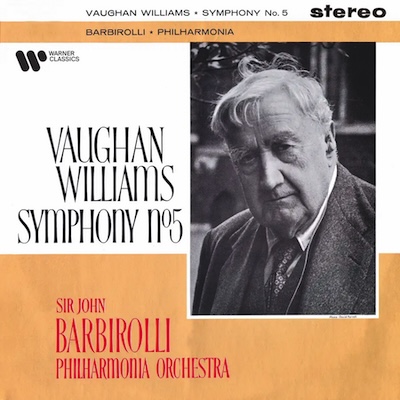
John Barbirolli (conductor)
Plhilharmonia
Warner Classics 9029673949
‘Glorious John’ was Vaughan Williams’s nickname for conductor John Barbirolli, and listening to this 1962 recording of the Fifth Symphony it is easy to hear why. Barbirolli in fact made the first studio recording of the Fifth in 1944, just eight months after the Albert Hall premiere, and that remains a historic document. But his return to the symphony in 1962 is blessed with vastly superior stereo sound and an open-hearted affection for the work which has only increased with the passing years.
The orchestra is also different, London’s Philharmonia replacing Manchester’s Hallé for the Kingsway Hall sessions. Barbirolli’s eloquent shaping of the multi-layered string writing at the symphony’s opening evokes vividly an atmosphere of growing trepidation, from which the brief E major episode emerges glowingly. The movement’s string-powered central crisis has bite and sizzle, and the rousing brass fanfare announcing the coda (co-opted from Vaughan Williams’s hymn tune ‘Sine Nomine’) is thrillingly visceral.
No conductor catches quite so graphically the mercurial temper of the Scherzo, dynamics snapping arrestingly from one level to another, and strings swirling like mist in a windy forest. The Philharmonia brass and woodwind players excel themselves, squawking in quasi-ghoulish fashion, with occasional snorts of derision. The sense of unruly, potentially violent forces underlying the movement’s often flimsy surface is potently communicated here, with every bar of the score energised and placed in context.
'In the Romanza, Barbirolli finds unmistakable sadness'
Where other interpreters prioritise the serene qualities of the Romanza, Barbirolli finds from the start an unmistakable sadness, even a sense of tragedy. His empathy for VW’s string writing – Barbirolli was a gifted cellist himself – is evident, and he draws a much wider range of emotional nuance from the strings in this movement than any other conductor. The results are surpassingly beautiful, but quietly heart-rending in the same moment.
The Passacaglia finale launches with buoyant optimism, threatened only by the rasp of the heavy brass in its central section. Barbirolli’s command of the music’s shifting moods and pulses is masterly, and the final pages are extremely moving, blending fortitude and poignancy in perfect measure.
The best digital recordings provide more transparency and dynamic range than this one, initially released on the much-loved and lamented EMI label, but the analogue sound has a plenitude and tonal fidelity which more than compensate. Barbirolli’s is, in short, a great performance of the Fifth.
Three other great recordings
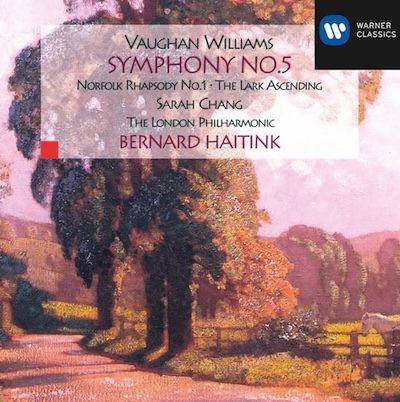
Haitink’s Fifth is arguably the best played, with wonderful contributions from the London Philharmonic’s upper strings in particular and pin-sharp modulations of dynamic. Haitink’s view of the symphony is notably dark-hued and unflinching, his spacious tempos and a transparent digital recording (made in 1994) affording unique insights into the music’s inner heart and workings. The Romanza has a stately, Brucknerian grandeur, while the performance as a whole has fewer ‘pastoral’ overtones than usual. But it is galvanising listening from start to finish. (Warner Classics 5554872)
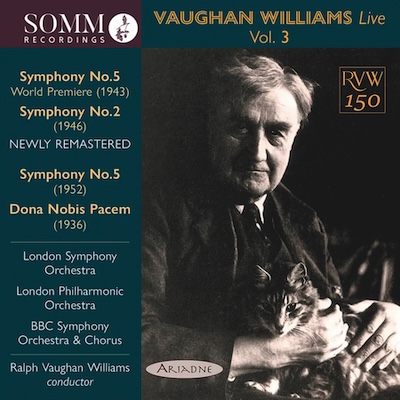
Ralph Vaughan Williams (conductor)
There are two notable live performances of the Fifth with the composer himself conducting, one of the 1943 premiere, the other from a BBC Prom in 1952. The premiere has some music missing (the recording acetates needed regular changing), but 1952 is complete. Both interpretations are astonishingly taut and fiery, the London Philharmonic responding with gripping intensity to VW’s direction. An indispensable listen, they trash the lazy assumption that VW is a comfortable, pipe-and-slippers composer. (Somm ARIADNE5019-2)
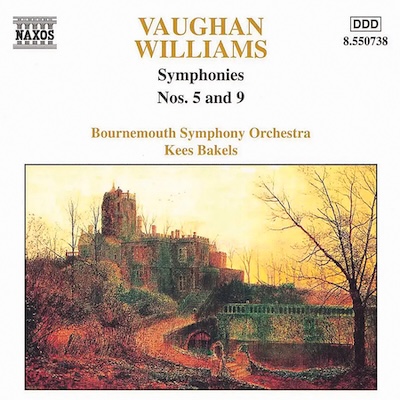
Dutch conductor Kees Bakels recorded most of the Vaughan Williams symphonies for Naxos in the 1990s, including this impassioned performance of the Fifth. Like VW himself, Bakels never underplays the turbulent elements in the music. The arching violins in the opening movement seem charged with tension, and the Scherzo crackles with nervous energy. Continuity dips a little here and there, but generally the Bournemouth Symphony Orchestra is urgently engaged and articulate in this riveting interpretation. (Naxos 8550738)
And one to avoid…
Richard Hickox’s complete recording of Vaughan Williams’s symphonies drew considerable acclaim when first released, but the Fifth is not its finest moment. The main problem is the cavernous acoustic of All Saints Church, Tooting, which renders fortes fierce and smudges woodwind detail in the Scherzo. Some of the string playing, cellos in particular, has excessive vibrato, creating textures that are lush rather than emotionally revealing. The overall effect is too often brash and lacks subtlety.


