By the summer of 1979, Aerosmith had everything a young rock band could possibly want – and were in danger of losing it all.
Just a few years earlier, the Boston five-piece had gone from scruffy club act to one of America's biggest rock bands. They had sold millions of records, were packing arenas and stadiums, and had become the embodiment of the new breed of American rock star: loud, cocky and seemingly indestructible (see also KISS, Ted Nugent, ZZ Top, Van Halen et al).
But behind the scenes, the Aerosmith machine wasn't running as smoothly as it might have looked from the outside.
They were also exhausted. Band members Steven Tyler (vocals), Joe Perry, Brad Whitford (both guitar), Tom Hamilton (bass) and Joey Kramer (drums) had spent years trapped in a punishing cycle of album, tour, album, tour, while their drug use spiralled.
By 1978, Whitford later recalled, the band members were consuming so heavily that they barely noticed how out of control things had become. Their previous album, 1977's Draw the Line, had cost more than $1 million to make and emerged from sessions so chaotic that the record seemed to document a band already beginning to fall apart.
Joe Perry would later reflect that Aerosmith had effectively become drug addicts who happened to be making music. And their private lives weren't making things any easier. Relationships were deteriorating, tempers were short, and the wives and girlfriends had been drafted into the band's increasingly poisonous internal politics.
Yet Aerosmith were still Aerosmith. They were still a huge American rock attraction, and in July 1979 they arrived in Cleveland to headline the World Series of Rock at Cleveland Stadium alongside AC/DC, Ted Nugent, Journey and Thin Lizzy. What happened backstage that day would become one of the strangest episodes in the band's history – and the moment when Joe Perry finally walked away.
And it all began... with a glass of milk.
At the top... and falling apart
The irony was that Aerosmith's problems arrived at almost exactly the moment when their success had become enormous.
The 1973 single Dream On had established them as serious contenders, while later albums Toys in the Attic (1975) and 1976's Rocks had transformed them into one of the defining American hard-rock bands of the 1970s. Their combination of Perry's irresistible riffs, Tyler's extravagant vocals and Hamilton and Kramer's locked-in rhythm section gave them a sound that was dirty, dangerous and unmistakably their own.
But the mythology of Aerosmith's 1970s excesses tends to make the period look rather more glamorous than it really was.
By the late 1970s, drugs were dominating the band's existence. Tyler and Perry's relationship was becoming particularly difficult – and, given that these two were the creative heart of the group, this friction was hitting the Aerosmith energy particularly hard.
What was driving the friction? Well, Perry's marriage to Elyssa Jerret had definitely become a sensitive topic between the two. Tyler felt that Elyssa was pulling Perry away from him and the band, resenting the time his closest musical partner was spending with her; their heavy drug use only intensified the tension. Jerret would eventually inspire some of Tyler's famously venomous lyrics in ‘Sweet Emotion'’.
The band were not simply having the occasional rock-star argument. They were becoming dysfunctional. And then came one night in Cleveland.
The backstage fight
On July 28, 1979, Aerosmith were headlining the World Series of Rock at Cleveland Stadium. The event itself was already pretty frenetic, with huge crowds and a notoriously wild atmosphere. But the drama inside the stadium was nothing compared with what was happening backstage.
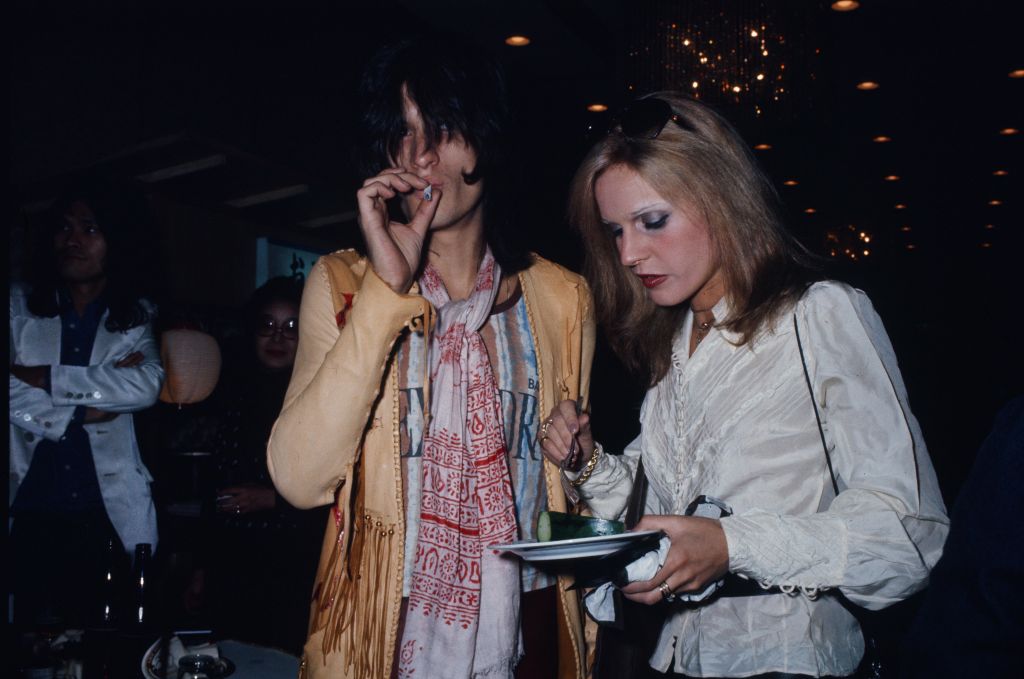
The wives of two band members – Elyssa Perry and Tom Hamilton's wife, Terry Cohen – got into an argument.
The precise sequence of events varies somewhat between recollections, but the basic story has survived remarkably intact. Terry Cohen made a remark that angered Elyssa Perry. The argument escalated. And then Elyssa Perry threw a glass of milk at Terry Cohen.
It sounds almost too ridiculous to have been the turning point in a major band's career.
It wasn't really the milk, of course. The milk was simply the thing that finally caused years of resentment to, er, overflow.
The confrontation spread from the women to the musicians. Steven Tyler became involved, and the argument between Tyler and Perry became heated. Tyler later recalled that the whole episode was drug-induced and that Aerosmith had been arguing constantly anyway. He also remembered the backstage atmosphere as one in which everybody was saying things they would later regret.
Soon after, Joe Perry left Aerosmith. Or, depending on whose version you believe, Tyler fired him. Either way, the result was the same. Aerosmith's classic lineup had been broken.
Perry's last Aerosmith performance was that Cleveland show, and he departed while the band were still working on their sixth album, Night in the Ruts. Jimmy Crespo was brought in to replace him, while some of Perry's existing material remained on the album. Perry subsequently formed the Joe Perry Project.
Looking back, Perry said that if he had stayed, the band would eventually have reached the same crisis because they desperately needed to stop, get sober and take stock of what they were doing. They were simply too committed to the relentless album-tour-album cycle to recognise it at the time.
So the glass of milk didn't exactly break up Aerosmith. But it was an undeniably vivid symbol of the frazzled, fractured state they were in at the time.
Exit Brad Whitford
If losing Joe Perry was a disaster, Aerosmith somehow managed to make things worse.
In 1981, rhythm guitarist Brad Whitford left the band to form Whitford/St. Holmes with former Ted Nugent singer Derek St. Holmes. With both Perry and Whitford gone, the two-guitar chemistry that had been central to Aerosmith's classic sound had disappeared.
The remaining members tried to carry on. But it didn't go well.
The 1982 album Rock in a Hard Place featured Jimmy Crespo and Rick Dufay on guitars, but Aerosmith were now a shadow of the band that had made Rocks and Toys in the Attic. Steven Tyler himself later admitted that something was missing.
And while the band struggled, Perry's own solo career failed to reproduce Aerosmith's success. The group that had symbolised 1970s swagger and excess had effectively disintegrated.
The bottom
By the early 1980s, the story had stopped being funny.
Aerosmith's commercial fortunes had collapsed. Tyler's drug problems continued, while Perry was also struggling with addiction and financial problems. The men who had once been playing stadiums were now dealing with the consequences of years of excess. Contemporary accounts describe Tyler losing his house, Porsche and private jet, while Perry was deeply in debt.
Even the music business seemed to have moved on.
Perry's Joe Perry Project never became another Aerosmith. Rock in a Hard Place was commercially disappointing. Tyler's health and drug use were becoming serious concerns. For a while, it genuinely looked as though Aerosmith's story had ended in the wreckage of the early 1980s.
Then something extraordinary happened. The band got back together.
The reunion
Perry and Tyler had spent years apart, but neither had found a satisfactory replacement for what Aerosmith had been. Perry eventually returned to the fold in 1984, and Whitford also came back. The original five-piece was reunited for the first time since Perry's departure.
Don't imagine things changed overnight, though.
Their first reunion album, Done With Mirrors, arrived in 1985 and failed to restore Aerosmith to their former commercial heights (fun fact: it did feature the band's take on the Joe Perry Project's 1980 track 'Let the Music Do the Talking', see below). Tyler was still struggling with drugs, and the band were essentially trying to resurrect a career that many people assumed was finished.
But then they got sober. And that's when things really started to turn a corner.
Aerosmith 2.0
Aerosmith's second act is one of the great comeback stories in rock.
For Permanent Vacation in 1987, the band worked with producer Bruce Fairbairn and began collaborating with outside songwriters, including Desmond Child and Jim Vallance. The result was an album designed to reconnect Aerosmith's classic swagger with the increasingly polished world of late-1980s rock.
It worked spectacularly.
'Dude (Looks Like a Lady)', 'Angel' and 'Rag Doll' all breached the US Top 20, while the album itself became Aerosmith's biggest-selling album in more than a decade. Its successor, 1989's Pump continued the revival, restoring the band to arena-rock royalty.
But the most important ingredient was still the relationship between Tyler and Perry.
For all the arguments, drugs, egos and disastrous decisions, the partnership that had produced Aerosmith's greatest music was still there.
Perry later described the post-reunion band as dramatically different from the group that had existed in the 1970s. The private lives had been sorted out, the drugs were being dealt with and the musicians could once again sit together after a show without the entire evening threatening to explode.
Aerosmith had not merely survived.
They had become a different kind of rock band – older, richer, cleaner and considerably more professional, but still capable of making themselves sound dangerous.
And their commercial second life was arguably even more extraordinary than the first. By the early 1990s, Pump had become a major success, and in 1991 Sony signed Aerosmith to a deal worth more than $30 million, one of the most lucrative recording contracts of its era.
The band that had seemed finished was suddenly one of America's biggest rock attractions again.
The milk wasn't the reason
Which brings us back to Cleveland.
It is tempting to tell the story as though Aerosmith's spectacular implosion was caused by an absurd domestic argument: one wife throws milk at another, the husbands start fighting, and Joe Perry quits one of America's biggest bands.
It's a brilliant story. It just isn't quite true.
Perry himself has said the departure was coming anyway. Aerosmith were exhausted, drug-addled and badly in need of time away from one another. The milk was not the cause of the collapse; it was the spark that landed on a pile of dry tinder.
And perhaps that's why the story has endured. Aerosmith didn't really almost break up just because somebody threw a glass of milk at someone else.
They nearly broke up because one of the biggest rock bands in America had become so dysfunctional that a glass of milk was enough to finish the job.
The remarkable part is what happened afterwards.
Joe Perry walked away in Cleveland in 1979. Brad Whitford followed him out two years later. Aerosmith staggered through the early 1980s and seemed destined for the history books. Yet Perry, Tyler, Whitford, Hamilton and Kramer eventually found their way back to one another, got sober and rebuilt the band into an even bigger commercial force.
Somewhere along the way, the glass of milk stopped being the story of Aerosmith's demise.
It became the opening scene of their comeback story.
Pics Getty Images