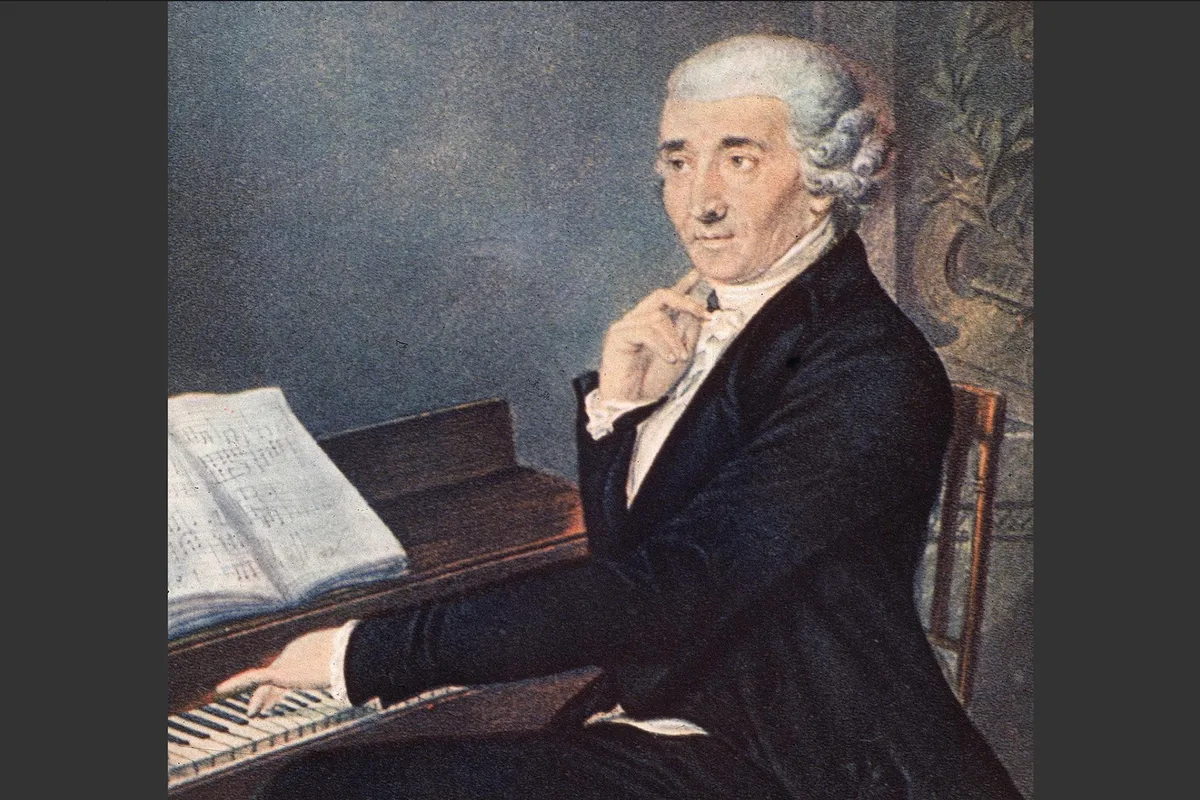
The great collections of music in a single genre produced by leading composers include some extraordinary works: JS Bach’s cantatas, Mozart’s piano concertos, Beethoven’s piano sonatas, Schubert’s songs, Wagner’s operas… In all these cases, the special skills of the composer match their chosen output to an uncanny degree. But alongside these examples, I would nominate as a peerless fusion of form and inspiration the symphonies of Joseph Haydn.
Haydn: the composer who took the symphony from childhood to maturity
Haydn (1732-1809) was not quite ‘the father of the symphony’, as he was christened in the days before the rich surrounding context of early symphonists in the 18th century had been fully explored. But he was something perhaps more remarkable: the most important force in the development of the form, who took the symphony on a journey from childhood to maturity, leaving us a legacy of over 100 works to explore. In his time, the symphony grew from entertainment and display to intricate musical argument – though as we shall see, Haydn never abandoned the idea that the symphony should always be hugely entertaining and witty, achieving the sublime through highly sophisticated musical discourse.
Along with other 18th-century pioneers – including, of course, Mozart – Haydn paved the way for the 19th century’s conception of the symphony as the pinnacle of abstract musical art. But today we have come to value Haydn not just as a precursor of Beethoven and Brahms but as a genius in his own right.
So, among those 100-plus works, where to start in exploring this treasure trove? Though there is no exact science, dividing the symphonies into categories and naming a prime example of each is as good a place as any…
Handy early symphonies: Morzin and Eisenstadt
Haydn received his musical training in the choir of St Stephen’s Cathedral in Vienna. His first permanent employer from 1757 was a Court Morzin who lived in what is now Czechia; it was he who stimulated Haydn’s first experiments in the symphonic form. It wasn’t a new development: among many other pioneers, the Viennese composer Georg Matthias Monn had written a symphony in four movements in 1740. (He was a composer whose music no less a figure Schoenberg later arranged, in a Cello Concerto of 1933.)
The rousing crescendo that begins Haydn’s first numbered symphony sounds as if it originated in Mannheim, though the scholar HC Robbins Landon, to whom we owe so much in the revival of these works, suggested a closer source in the Viennese music of Florian Leopold Gassmann (1729-74).
Morzin was a supportive enthusiast, but found himself short of money and had to disband his orchestra. By then Haydn had already written some 20 lively pieces, and in 1761 he was able to secure a life-changing appointment with Prince Paul Anton Esterházy as Vice-Kapellmeister, working initially at Eisenstadt where regular concerts took place twice a week.
'I had no choice but to become original'
A famous statement about the nature of his creativity was later given by Haydn to his biographer Georg August Griesinger, and unlike many such statements this one has the ring of authenticity. ‘My prince was satisfied with all my works; I received approval. As head of an orchestra I could try things out, observe what creates a good effect and what weakens it, and thus revise, make additions or cuts, take risks. I was cut off from the world, nobody in my vicinity could upset my self-confidence or annoy me, and so I had no choice but to become original.’ The notion of ‘becoming original’ is absolutely central to Haydn’s symphonic output.
Haydn Symphonies No. 6, ‘Le Matin’; No. 7, ‘Le Midi’; & No. 8, ‘Le Soir’
The rising of the sun marks the beginning of this set of symphonies from 1761, apparently directly requested by Prince Anton Esterházy. It was said that he commissioned four quartets (but there are actually three symphonies) depicting the times of the day. Programmatic content is actually slight: only the sunrise at the start of No. 6 and a storm at the end of No. 8 are directly pictorial in the style of Vivaldi’s Four Seasons (a popular work at the time).
Much more to the point is the extensive writing for solo instruments which make them sound more like chamber music than orchestral works. Already, originality is evident in the recitative for solo violin in No. 7, and the florid writing for two flutes and solo violin, with a cadenza for violin and cello. Oboe and bassoon are to the fore in No. 8, and the storm breaks in the finale with leaping flute figures and jagged violin lines, with a cello solo before the final tumult.
Esterháza and Sturm und Drang
As Haydn develops the form, he experiments constantly. Very striking is his incorporation of earlier elements into the classical symphony. No. 22, called ‘The Philosopher’, of 1764 has a plainsong-style melody heard on cor anglais, while in No. 30 of 1764-5 there is a genuine Easter chant in the first movement, giving the work its nickname ‘Alleluja’. For those in search of more secular sources, there’s an exuberant symphony No. 31 featuring four horns at full blast; this has military and hunting overtones.
Engaging with Sturm und Drang
However, the major musical development of this period is Haydn’s increasing emphasis from Symphony No. 39 onwards on symphonies in the minor mode as he engages with the literary movement known as Sturm und Drang (Storm and Stress). His connection to it may be linked through the very intense, personal style of CPE Bach, from whom Haydn claimed to have learned, but it surely matched Haydn’s desire to give the concept of the symphony substance and depth.
In 1766, George Werner, the Kapellmeister of the Esterházy family, died. Haydn took on his role, creating many more demands on his time, while in the same year the family began a move to the remote palace of Esterháza. He continued to write symphonies and returned to high output in the years 1770-74; however, those he did create at the height of his involvement with Sturm und Drang are passionately felt, among them No. 49 in F minor ‘La Passione’ which uses the old church model of four slow-fast-slow-fast movements.
These works are balanced by exuberant major-mode symphonies such as the splendid No. 48 in C major ‘Maria Theresa’, with blazing trumpets and horns. And from 1772, No. 45, in the highly unusual key of F sharp minor, has a memorable story attached to it. With his musicians forbidden to bring their families to Esterháza, Haydn gently pointed out their wish to be reunited with them by writing a last movement with reducing scoring where the players gradually leave. Hence the symphony’s nickname, the ‘Farewell’.
Symphony No. 44 in E minor, ‘Trauer’
This tempestuous work is surely the greatest symphony of this period. From its jagged unison opening through simmering tension, to the outburst of semiquavers thrown between first and second violins, it is clearly a work of Sturm und Drang. Unusually as the second movement, there is an ascetic minuet which is a Canone in Diapason (or canon at the octave), offset by a trio in which tranquil violins are joined by an eerie horn at the top of its register.
The eloquent, elaborate Adagio is clearly one that Haydn loved, as he reportedly asked for it to be played at his own funeral (and it was played at a Berlin memorial concert in 1809). The intense Finale is argued with constant, concentrated power: a unison theme echoing the first movement is used to generate the thematic material and sweeps across the development section only to subside for a moment. Then the unison figure sweeps up a diminished seventh, before the final outburst.
Haydn theatrical symphonies, 1774-82
This was the period when Haydn’s involvement in writing operas for the palace of Esterháza grew, and the influence can be heard in some of the symphonies of this period, notably No. 60, ‘Il distratto’, which was pulled together from a set of incidental music for a play about an absent-minded man. Here, references to folk song, more Gregorian chant and even at one point a reminiscence of the ‘Farewell’ Symphony serve to point up the forgetfulness of its subject.
Some of these symphonies, including No. 73, ‘La Chasse’, have whole movements that served as opera overtures: in this case the finale is the overture to the opera La fedeltà premiata. But notable for the period is the emergence of a new kind of melody in the slower movements, with a nobility that was to become a trademark of Haydn’s last period.
Haydn Symphony No. 70 in D
This is a quirky and disarmingly clever symphony which combines fun with contrapuntal genius.It was written apparently for the re-opening of the Esterháza opera house, which had disastrously burned down, and was first performed on 18 December 1779. It is short but inspired, and the opening Vivace con brio shows how brilliantly Haydn can work with limited material – in this case two notes from the opening theme form the basis of a canonic development section.
Then the Andante is a set of double variations, contrasting the major and minor modes (in a way similar to Haydn’s wonderful keyboard Variations in F minor/major). We might not be able to perceive, though perhaps we can sense, that here the top and bottom lines are written in counterpoint so that they can be inverted in the second half! The finale is one of my all-time favourites, starting with a brittle one-note theme of repeated Ds but soon, within its three-minute length, tumbling into a three-part fugue of the greatest energy and virtuosity.
Haydn international symphonies, 1782-90
By 1779, Haydn was famous around Europe, and it was now possible for him to accept commissions and build relationships with publishers. He was clearly determined to make the most of these opportunities and seized the chance to write attractive symphonies for a wide audience. He wrote to a French publisher, ‘Last year I composed three beautiful, elegant and by no means over-lengthy symphonies… they are all very easy, and without too much concertante [i.e. solo passages].’
At this time, Haydn was hoping to visit London, but that would have to wait until later. However, there was a commission ready from the sophisticated young aristocrat Claude-François-Marie Rigoley, Comte d’Ogny, for Le Concert de La Loge Olympique in Paris, which produced six extrovert symphonies. Here, Haydn was dealing with a much larger orchestra than that at Esterháza (with 40 violins and ten double basses) and he especially relished the opportunity for prominent wind writing.
At their first performances in 1787, they were rapturously received both by the Parisian audience in the Tuileries, the players themselves (who included composer Luigi Cherubini on the violin) and the critics. As HC Robbins Landon has aptly summarised it, these Paris Symphonies are ‘a remarkable fusion of brilliance, elegance and warmth’.
Confusion regarding order and copyright
The order of these symphonies was confused on publication, but it seems clear that Nos 83 and 87 were definitely written in 1785, plus perhaps No. 85, and Nos 82, 84 and 86 in 1786. Some of the witty allusions in these symphonies explain their titles: the French folk song in No. 85, the clumping dance finale of No. 82 (see p32), and the hiccuppy second subject of No. 83. No. 84 has an imposing slow introduction, which would become an important feature of Haydn’s later symphonies: ever-expanding in scope, this period pushes Haydn’s symphonic thinking forward to new heights.
After this great success in Paris, a follow-up was entrusted to the violinist Johann Tost, to whom Haydn gave Symphones Nos 88 and 89. Tost added a further one by Adalbert Gyrowetz which he passed off as Haydn’s – one of many duplicitous attributions which Haydn attracted from publishers in an attempt to increase sales by using a famous name. A similar copyright tussle surrounded Nos 90-2, which Haydn also wrote for Comte d’Ogny but at the same time sold to Prince Kraft-Ernst, sending the scores to the former and the orchestral parts to the latter.
The hilarious finale of No. 90 shows Haydn’s playfulness at its height: he wraps up the symphony with suspicious speed and a noisy cadence, but then (having doubtless encouraged the audience to applaud) he starts quietly again with a long coda. If the second half is repeated, the joke is doubled. No. 92 has become famous as the ‘Oxford’ Symphony because it was played in the city’s Sheldonian Theatre when Haydn received the degree of Doctor of Music in July 1791. By then, Haydn’s sights had turned back to England for the last stage of his symphonic odyssey.
Haydn Symphony No. 88 in G
This has always been one of Haydn’s most popular symphonies, justifiably so because of its sunny disposition allied to constant inventiveness. The slow introduction provides an imposing opening, and the Allegro starting on strings alone is marvellously varied as it skates from key to key. The second movement – actually slow, marked Largo – with its combination of oboe and cello, attracted Brahms who (doubtless apocryphally) said, ‘I want my Ninth Symphony to sound like this.’
It is a set of variations with interruptions, the most startling of them by the trumpets and timpani which Haydn has held back. The rustic minuet has a bagpipe-like trio, evoking the folk music of Hungary and giving rise to the German nickname ‘mit dem Dudelsack’. The glory of the symphony is its Finale: combining elements of sonata and rondo, it bustles away and then erupts into a fortissimo canon which takes the breath away as it keeps us on the edge of our seats as we wait for the theme to return. You just have to exclaim: marvellous!
Haydn London Symphonies, 1791-5
Haydn’s circumstances changed in 1790 with the death of Nicolaus Esterházy, his splendid patron; his son Anton disbanded the orchestra, and though Haydn was retained in his service he was free to travel. He went to Vienna where he was approached by the impresario Johann Peter Salomon with an offer to come to London, and he arrived in January 1791. His reaction to our capital city was mixed: ‘endlessly huge… various beauties and marvels… the noise as they sell their wares is intolerable’. But he
was treated as an honoured guest with many invitations, and repaid the honour with six superb symphonies, followed by another six for a subsequent visit in 1794-5.
These ‘London’ symphonies would provide a benchmark of what could be achieved in symphonic form in the 18th century, yet they remain quintessentially Haydnesque in their combination of sharpness, grace and ingenuity. As that great observer of the classical style, Charles Rosen, remarks: ‘There is not a measure, even the most serious, of these great works which is not marked by Haydn’s wit; and his wit was now grown so powerful and so efficient that it has become a sort of passion, a force at once omnivorous and creative.’
Haydn Symphony No. 103 in E flat, ‘Drumroll’
The first set of six London symphonies was performed to acclaim by Salomon and his orchestra; the second six, though Salomon commissioned them, were performed by Giovanni Battista Viotti’s orchestra at the King’s Theatre Haymarket. No. 103 was included on 2 March 1795 and made an immediate impact.
The ‘call to attention’ of a timpani roll before the low strings’ sinister opening is very striking, but what is so clever is Haydn’s twist in returning to that opening as the first movement reaches its climax. The second movement is a set of variations echoing Austrian melodies, and the minuet is based on a snappy syncopated figure which has been linked to yodelling. The Finale is amazing: marked Allegro con spirito, from a traditional call by two horns, it develops an incredible web of imitative solos juxtaposed with full orchestral outbursts, with displaced accents and harmonies, before gathering its strength for a final joyous outburst.