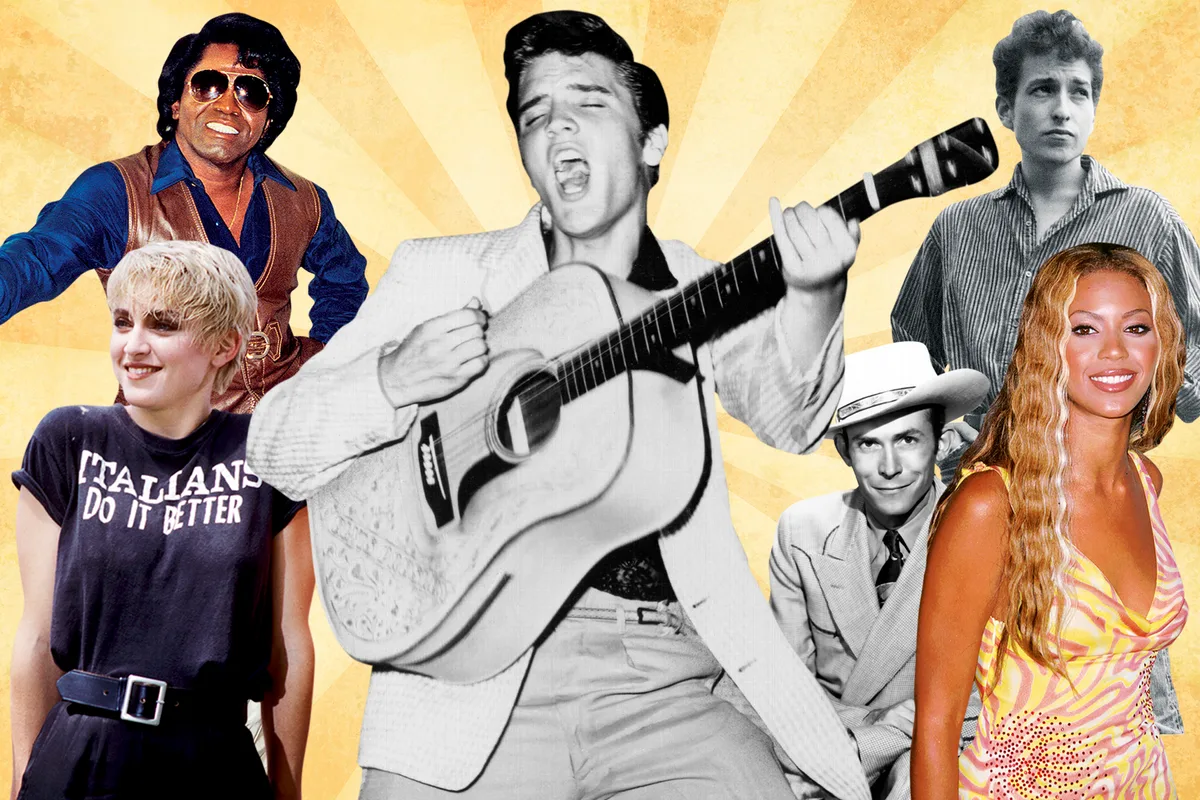
It seemed a simple enough idea: pick the top 50 solo artists ever to have come out of the United States, and rank them in order of importance. But the reality was brutal – the list of artists we couldn’t find room for is in itself a formidable collection of talent.
For our criteria, we looked for impact, influence and legacy – which artists cast the longest shadows? Which ones changed the course of music history?
We tried hard to be across all styles, genres and periods, which led to furious debate as to how one even goes about ranking, for example, Nas against Fats Domino? It’s a thankless task.
We stuck as strictly as we could to solo artists, so no room for band leaders or artists whose best work was made as part of a group (sorry Jimi Hendrix, Frank Zappa and Duke Ellignton).
So load up the jukebox, brew a big pot of coffee and dive in – just don’t blame us if we’ve misplaced your favourite artist!
51 US solo artist icons ranked
51. Lana Del Rey

There’s more than a trace of classic artists like Johnny Cash to the music of Lana Del Rey. Her cinematic presentation of songs about romance, doomed relationships and glamour appeal to audiences of all ages and backgrounds.
After all, songs like ‘Video Games’ and ‘Summertime Sadness’ are as relatable as her melancholic storytelling of vintage Americana is timeless.
50. Diana Ross

Since leaving The Supremes in 1970, Diana Ross has enjoyed a solo career with hits like ‘Ain’t No Mountain High Enough,’ ‘Chain Reaction’ and ‘Upside Down. Her powerful voice and dynamic stage presence has seen her retain her seat on pop’s top table for more than half a century, winning the Grammy Lifetime Achievement Award twice.
49. Tom Waits

He may not be a household name, but speak to musicians and they all talk about Tom Waits with the kind of hushed reverence that speaks volumes.
After all, he’s had his songs covered by Bruce Springsteen, Los Lobos, Lucinda Williams, Marianne Faithfull, The Ramones, Johnny Cash, Willie Nelson, Solomon Burke, Alison Kraus and Robert Plant, and Joan Baez – Scarlet Johannson even recorded an entire album of his songs.
He’s recorded with Keith Richards and performed with The Rolling Stones, Neil Young and Roy Orbison, appeared in movies by Robert Altman, Francis Ford Coppola, Terry Gilliam, Jim Jarmusch and Martin McDonagh, and has a place in the Rock and Roll Hall of Fame.
48. Roy Orbison

‘The Big O’ was known for his dramatic ballads, full of doom and despair.
He got his break recording for Sam Phillips’ Sun Records in Memphis, alongside the likes of Elvis Presley, Jerry Lee Lewis, Johnny Cash and Carl Perkins, but, dissatisfied with singing rockabilly, he established himself as a songwriter, before his breakthrough transatlantic hit ‘Only The Lonely’ saw him rightly recognised as having one of the finest voices in rock’n’roll history.
Through the 60s, he had hits including ‘Oh, Pretty Woman’, ‘Crying’ and ‘In Dreams’, before fading from stardom. But an unexpected revival in the 80s with ‘I Drove All Night’ and ‘You Got It’ introduced him to a new audience.
His was perhaps the most distinct voice in the supergroup The Traveling Wilburys, alongside Bob Dylan, George Harrison, Tom Petty and Jeff Lynne, before a heart attack took his life at the peak of his resurgence. He was 52.
47. Patti Smith

Hailing from New Jersey, Patti Smith fused the rock she’d grown up on (Velvet Underground, Jimi Hendrix and The Rolling Stones) with poetry and punk, channelling the spirit of William Burroughs and Rimbaud on the seminal Horses (1975).
Her fearless approach to music and art has set her apart from the mainstream, but she has influenced generations to value art that challenges and speaks the truth.
46. Charles Mingus

Descending from European, Chinese and Africa-American ancestors, bass player, band leader and composer Charles Mingus never really felt like he belonged.
His music is infused with anger, persecution and alienation, bringing politics and deep emotions to composition and performance that redefined jazz by introducing blues, gospel and classical influences.
A pioneer of collective improvisation, Mingus left a catalogue of powerful albums, including Mingus Ah Um (1959), The Black Saint and the Sinner Lady (1963) and Mingus Mingus Mingus Mingus Mingus (1964), that defy comparison.
Motor neurone disease took his ability to play the bass, but he continued to compose and collaborate until his death in Mexico at 56.
45. Iggy Pop

Think of raw energy and you might conjure an image not a million miles from Iggy Pop. Known as the Godfather of Punk thanks to the influence of the band he fronted, The Stooges, Iggy branched out as a solo artist, collaborating with David Bowie on The Idiot and Lust For Life (both 1977).
His live performance (generally shirtless) was as intense as it gets, with self-destruction taking centre stage. The ultimate anti-hero, he was presented with the 2020 Grammy Lifetime Achievement Award.
44. John Coltrane

One of the defining musicians of the 20th century, John Coltrane’s spiritual intensity, harmonic innovation and technical mastery helped transform jazz. His landmark A Love Supreme (1965) and Giant Steps (1960) rewrote the rules of improvisation.
Coltrane’s experiments with modal and free jazz shifted the genre’s boundaries, inspiring generations of musicians and listeners worldwide. As Miles Davis observed, “He was searching all the time.”
43. Kanye West

A hugely controversial figure today, Kanye West is undoubtedly one of the most influential figures in American music over the last 30 years, reshaping hip-hop’s sound and ambition.
Albums like My Beautiful Dark Twisted Fantasy (2010), Graduation (2007) and The College Dropout (2004) set new standards in production and storytelling. But his image has been tainted by controversies, inflammatory public statements and a series of accusations of physical and sexual violence.
His influence on music is undeniable, but whether his reputation has been permanently broken only time will tell.
42. Mavis Staples

Having cut her chops in one of the greatest gospel groups of all time, under the tutorship of her father, Pops Staples and alongside her siblings in The Staple Singers, Mavis forged a remarkable career as a solo singer.
Her eponymous 1969 album was produced by Steve Cropper of Booker T & the MGs, and included covers of rhythm & blues songs by Sam Cooke and Otis Redding.
Her deep and soulful baritone gives everything she sings a richness and warmth, but it’s the depth of the soul with which she infuses everything she does that has set her apart from contemporaries.
She continues to release critically acclaimed music in her 80s, winning awards, and has collaborated with everyone from Bob Dylan to Prince, Jon Batiste to Dolly Parton.
41. Ella Fitzgerald

Frank Sinatra called her ‘The greatest popular singer in the world, bar none’ and even today, close to a century after she began singing on the streets of Harlem to make ends meet as a child, she remains the benchmark for phrasing, timing and the sheer joy of singing.
Her pioneering scat improvisation expanded the voice into an instrument – just listen to ‘How High the Moon’, ‘Mack the Knife’ and the timeless ‘Summertime’.
40. Lou Reed

Lou Reed is perhaps the grandfather of alternative music. As part of the Velvet Underground, Lou Reed’s place in music history was assured, but when he left them in 1970, he began a hugely influential solo career.
Transformer (1972) saw Reed working with David Bowie and Mick Ronson on an album that defined a time and place, delivering the classic single ‘Walk On The Wild Side’.
39. Nas

The New York rapper and producer captured urban life with cinematic clarity on his phenomenal debut Illmatic (1994), which is generally considered to be one of the greatest hip-hop records ever made. Jay-Z said Nas has ‘One of the best bodies of work ever’, which shows the deep respect he commands among his peers, and rivals.
38. Fats Domino

Mixing jazz, Latin, boogie-woogie, Cajun and blues, piano great Fats Domino was discovered playing in the clubs of his native New Orleans.
His laid-back delivery set him at odds with the nascent rock’n’roll crowd, yet his glorious ‘Ain’t That A Shame’ and pounding ‘Blueberry Hill’ were huge. He influenced everybody from Elvis Presley to The Beatles, and was loved as much for his cheerful persona as his wonderful music.
37. Kendrick Lamar

As Barack Obama said, ‘Kendrick Lamar is one of the most powerful voices of his generation.’ More than a musician and artist, Lamar is a defining force in 21st century America.
An innovator whose profound storytelling has had a phenomenal cultural impact, Lamar’s albums such as Good Kid, M.A.A.D City (2012), To Pimp a Butterfly (2015) and DAMN (2017) redefined hip-hop by blending jazz, funk, and spoken word with sharp commentary.
It’s easy to see why his work won him a Pulitzer Prize – he has taken rap to the realms of high art, without losing any of its authenticity. And in ‘Alright’, he has created an anthem for social justice.
36. Bessie Smith

Known as the Empress of the Blues, Bessie Smith personified the emotional impact of the blues. On recordings like ‘Downhearted Blues’ and ‘St Louis Blues’, she transformed personal struggle into universal storytelling, influencing generations of jazz and popular singers.
One of the finest pre-war blues singers, Smith rode the wave of the Great Depression, continuing to perform on Broadway, appearing on the silver screen and recording for Columbia and Okeh records, before being killed in a car crash in 1937.
35. Howlin' Wolf

The 1962 album Howling Wolf Sings The Blues may be the most appositely named records of the 20th century. With a deep, growling voice and his trademark howl, the giant (both physically and musically) Howlin’ Wolf (born Chester Burnett) was a force to be reckoned with.
As you can hear on ‘Smokestack Lightning’, ‘Killing Floor’ (covered brilliantly by Jimi Hendrix) and ‘Little Red Rooster’, the Wolf embodied the blues, delivering every sound with an almost unsettling emotional intensity.
It’s fair to say that he was vital in shaping the attitude of modern popular music. As Sun Records’ boss Sam Phillips said, "When I heard Howlin' Wolf, I said, 'This is for me. This is where the soul of man never dies.'"
34. Jay-Z

The Brooklyn rapper continues to be one of the most influential figures in hip hop. Known for his vivid narratives and intricate wordplay on albums like Reasonable Doubt (1996), The Blueprint (2001), and The Black Album (2003), he expanded hip hop both artistically and commercially.
Billboard and Vibe named him the greatest rapper of all-time, and during his time as head honcho of Def Jam, he helped launch the careers of artists including Kanye West and Rihanna.
33. Marvin Gaye

After an apprenticeship singing gospel and doowop, Marvin Gaye hooked up with his brother-in-law Berry Gordy at his fledgling Motown record label in Detroit, singing a perfect blend of pop and rhythm & blues on hits like ‘I Heard It Through the Grapevine’ and ‘How Sweet It Is (to Be Loved by You)’, as well as duets such as ‘Ain't No Mountain High Enough’ with Tammi Terrell.
But it was with his stunning 1971 self-produced album, What’s Going On, that made sure of his place in 20th century music history.
A remarkable personal journey, What’s Going On is a commentary on the political, social and racial divides of America, as seen through the eyes of a Vietnam Veteran returning home to a country wrought apart by corruption, poverty and discrimination.
Regularly cited as one of the greatest albums of all time, it spearheaded a seismic shift of black artists taking complete control of their own artistic output.
Subsequent notable albums included the spicy Let’s Get It On (1973) and the devastating Here, My Dear (1978). Tragically, Marvin Gaye was shot dead by his own father the day before his 45th birthday in April 1984.
32. Lauryn Hill

One of the greatest female rappers of all time, Lauryn Hill was pivotal in the emergence of neo soul and has won more Grammys than any other female rapper.
Having tasted phenomenal success with The Fugees, whose album The Score (1996) contained the global smash hits ‘Killing Me Softly’ and ‘Ready Or Not’, she launched a career on her own.
Her debut solo album, The Miseducation Of Lauryn Hill (1998), has sold over 20 million copies, and was named by Apple Music’s Best 100 Albums list as the greatest album of all time, ahead of Michael Jackon and The Beatles.
31. Willie Nelson

Texan singer-songwriter Willie Nelson’s early career had many highs – notably songwriting credits on hits like Patsy Cline’s ‘Crazy’ and ‘Pretty Paper’ for Roy Orbison.
But, despite recording hundreds of tracks for a number of labels throughout the 1960s, he remained out of step with the country musicians that ruled Nashville due to his unusual vocal style and his refusal to buy into the rhinestone trimmings.
He disliked the polished arrangements of the country music establishment: "After all the voices and the strings and all those things had been put in, it sounded beautiful but it wasn’t me."
Leaving Nashville for Texas, he found himself more at home with the hippie movement, where his music became looser and incorporated elements of folk and rock.
Signing to Atlantic Records (more commonly the home of soul, blues and jazz artists) he became the de facto leader of the emerging ‘outlaw’ country movement, changing forever the hegemony Nashville held on country music, and allowing country artists the freedom to explore their art with truth and depth.
30. Tupac Shakur

The man Eminem called ‘The greatest rapper of all time’ balanced the energy of the streets with an emotional depth that allowed him to redefine what rap could be.
His versatility allowed him to create protest anthems like ‘Changes’, soulful tributes like ‘Dear Mama’ and party classics like ‘California Love’. He was killed in a drive-by shooting, and despite many theories, his murder remains unsolved.
29. Buddy Holly

At a time when rock’n’roll stars wore greased-back hair, leathers and attitude, a young Texan in horn-rimmed glasses couldn’t have seemed more out of step. But Buddy Holly wasn’t like anyone else.
He wrote and sang his own songs, mixing country with rock’n’roll. Songs like ‘Peggy Sue’, ‘Rave On’ and ‘It's So Easy’ were driving rockers, melodic, had killer hooks and what’s more, any budding young guitar player could copy them.
Which is exactly what a whole generation did – not least the young Beatles, Bob Dylan and Elton John. Paul McCartney called him an ‘all-inclusive one-man band’, and he and John Lennon learned to write songs by copying Buddy’s (the first recording they ever made was of ‘That’ll Be The Day’).
At his last recording session before his death at just 22 in a plane crash while on tour, Holly had recorded ‘True Love Ways’, an elegant ballad, backed by a full orchestra. It suggests that Holly was just getting going and his tragic death robbed the world of unimaginable musical riches.
28. Dolly Parton

Timeless hits like ‘Jolene’, ‘I Will Always Love You’, and ‘9 to 5’ are testament to Dolly Parton’s brilliant storytelling power. But as well as being one of the finest country singers ever, Dolly Parton is a brilliant businesswoman – the Dollywood brand alone shows her entrepreneurial genius.
A national treasure, Parton is an inspiration to women in business, and is an example in philanthropy. But it’s as a singer and songwriter that we’re focusing on here – and the facts speak for themselves.
She sold over 100 million records and has been given every award going – apart from ones that she turned down, such as when she responded to a move to erect a statue to her in Tennessee by saying "Given all that is going on in the world, I don't think putting me on a pedestal is appropriate at this time."
27. Paul Simon

As the songwriter for the hugely popular duo Simon & Garfunkel, Paul Simon was already one of America’s favourite songwriters even before he started out on a solo career.
With an ear for melody, a beautiful voice and wonderful ability as a guitar player, Simon was always looking for new ways to explore his musicianship.
The 70s saw him deliver album after album of timeless songs such as ‘Mother and Child Reunion’, ‘50 Ways to Leave Your Lover’, ‘Slip Slidin’ Away’ and ‘Still Crazy After All These Years’, but it was 1986’s Graceland LP that hit the highest highs.
Fusing a wide variety of styles – notably, and controversially, South African music during the period of Apartheid – it sold more than 16 million copies. He continues to create vital and challenging music – 2023’s Seven Psalms being a prime example of later-period greatness.
26. Aretha Franklin

Coming from a strong gospel background (family friends included Sam Cooke and Martin Luther King Jr), Aretha’s early recordings we all gospel songs, and she toured with many of the great gospel acts of the day, including The Soul Stirrers, for whom Sam Cooke was still singing.
Like Cooke, she switched to secular music, signing with Columbia Records, for whom she made a number of records in the early 1960s. None sold particularly well and after the label dropped her, it seemed her career had stalled.
After signing with Atlantic Records, she recorded I Never Loved a Man the Way I Love You (1967), an album rightly proclaimed today as one of the greatest albums of the 20th century, and which included classic songs such as ‘Respect’, ‘Do Right Woman, Do Right Man’, the title track and an impassioned version of Cooke’s ‘A Change Is Gonna Come’.
Known as the Queen of Soul, she followed this success with more great albums and hit singles including ‘Think’, ‘Chain Of Fools’ and ‘Say A Little Prayer’. The first female artist inducted into the Rock and Roll Hall Of Fame, she won a whopping 18 Grammy awards and was awarded the Presidential Medal of Freedom.
25. Billie Holiday

So powerful was Billie Holiday’s recording of ‘Strange Fruit’, a song written by Abel Meeropol after seeing a photograph of the bodies of Thomas Shipp and Abram Smith hanging from a tree following a lynching in Marion, Indiana in 1930, that her record label baulked at releasing it.
They did, however, give the singer permission to issue the song on another label, Commodore, for whom it sold over one million copies. Time called it the Best Song of the Century, while renowned Atlantic Records producer Ahmet Ertegun called it "A declaration of war... the beginning of the Civil Rights movement."
For Holiday – or Lady Day as she became known – singing the truth was as important as beauty. But her personal life was beset by abusive partners, legal issues, drug abuse and alcoholism, and she died aged 44 in 1959 from cirrhosis of the liver.
24. Chuck Berry

John Lennon once said, "If you tried to give rock'n'roll another name, you might call it 'Chuck Berry'".
And if you listen to ‘Johnny B Goode’, ‘Sweet Little Sixteen’, ‘Maybellene’ or ‘No Particular Place To Go’, it’s hard to dispute – these songs are the very essence of rock’n’roll, distilled on 45rpm singles that so encapsulated the time that, in hindsight, you might call Berry the poet of his generation.
His personal life was littered with accusations of wrongdoing, including a three-year sentence for transporting an underage girl across state lines for the purpose of having sex. Even his own autobiography paints a rather dim picture of Berry as a person, but his musical legacy cannot be overstated.
23. Otis Redding

Aretha Franklin said that Otis Redding was one of the greatest singers ever, and she was right. The raw emotion in his delivery was born out of a gospel background, and his warm personality shone through every recording.
His 1965 Otis Blue/Otis Redding Sings Soul LP is packed with examples of his genius – 'Shake, My Girl' and 'I’ve Been Loving You Too Long' to mention but a few. The seminal '(Sittin’ On) The Dock of the Bay' was recorded just three days before his tragic death in a plane crash in December 1967 at just 26 years old.
22. Eminem

The Slim Shady LP (1999) made Eminem a household name, and his next two albums, The Marshall Mathers LP (2000) and The Eminem Show (2000) served to cement his position as one of the most popular rappers in the world.
Indeed, the latter is still the best-selling hip-hop album of all time, with sales of over 27 million copies. His collaboration with Dr Dre on these records was vital, but his unflinching honesty, lyrical brilliance and dark humour made for a winning combination.
His list of awards is breathtaking, including 15 Grammys and an Oscar.
21. Woody Guthrie

‘This Machine Kills Fascists’ was the legend scrawled on Woody Guthrie’s guitar. The Oklahoma singer and songwriter spent much of his life traveling the United States writing, sharing and learning songs, especially those that represented the poor, the downtrodden and the workers that kept the country moving.
Among his most enduring songs is ‘This Land Is Your Land’, considered by many America’s alternative national anthem.
His influence on folk musicians like Pete Seeger, Bruce Springsteen, Bob Dylan, Joe Strummer, Steve Earle and Johnny Cash, among countless others, is immeasurable but his message was simple: people deserved to be treated fairly and equally.
20. Lead Belly

The legend of Huddie William Ledbetter is almost as captivating as the musical legacy of this Louisiana singer, songwriter and guitar player.
Many of his songs became standards, including ‘Midnight Special’, ‘Goodnight Irene’ and ‘Cotton Fields’. Born in 1888, or possibly 1889, Lead Belly played around the clubs of Shreveport, Louisiana and travelled the South before being sentenced to 30 years in a Texan jail for murder in 1918.
After serving just 7 years, he was pardoned, after writing a song to the Governor. But in 1930, he was back in jail, this time in Louisiana, for attempted murder.
It was here that folklorists Alan and John Lomax discovered him, and, on his release in 1934, he began touring the country, performing alongside blues and folk musicians, where his name became entrenched in the annals of American music.
19. Beyoncé

With an influence spanning music, fashion, business, cinema and culture, Beyoncé Knowles is one of the greatest entertainers of all time, and one of the most significant artists of the 21st century.
After leaving the hugely successful group Destiny’s Child, she launched her solo career with Dangerously In Love (2003), and her ability to reinvent herself again and again has seen her in more recent years exploring various projects in depth.
Her 2024 album Cowboy Carter, for example, saw her exploring country music – traditionally largely the domain of white artists.
But collaborating with the likes of Dolly Parton, Paul McCartney and Stevie Wonder is the perfect illustration of how she not only breaks down boundaries but obliterates them. Every one of her studio albums so far has gone straight into the Billboard 200 chart at number one.
18. Muddy Waters

The most notable of the southern musicians who headed north to Chicago seeking fame and fortune, McKinley Morganfield – known to the world as Muddy Waters – was born in Mississippi in 1913, and encouraged to pursue music after hearing a recording of his performance made by Alan and John Lomax.
This gave him the confidence to head north, and, playing in the Chicago blues clubs, he switched from acoustic to electric guitar – mainly so people could hear him in noisy bars.
His early recordings for Chess Records included ‘I'm Your Hoochie Coochie Man’, ‘I Just Want to Make Love to You’, ‘Mannish Boy’ and ‘Got My Mojo Working’.
His influence on rock’n’roll and rhythm & blues artists is best illustrated by The Rolling Stones taking their name from one of his songs, while his songs have been recorded by Jimi Hendrix, Led Zeppelin, Eric Clapton and The Allman Brothers Band. His career lasted from the 1930s until his death in 1983.
17. Johnny Cash

‘The Man In Black’ was born on an Arkansas cotton farm in 1932, finding fame as a rockabilly singer at Sun Records in Memphis, Tennessee in the 1950s.
Among his many classic recordings for Sun were ‘I Walk The Line’, ‘Cry Cry Cry’ and ‘Folsom Prison Blues’ (known for its exceptional opening line "I shot a man in Reno just to watch him die", which Cash explained came about when he tried to think of the worst reason to kill someone).
A prolific recording artist, he released some 76 studio albums during his lifetime, as well as many live albums – including the seminal Live At Folsom Prison (1968). With an unrivalled ability as a storyteller, a determination for authenticity and a strong sense of rebellion, Cash represented the oppressed and gave a voice to the outsiders.
A resurgence in critical and commercial success in the 1990s introduced him to a new generation, and he continued to record winning albums with producer Rick Rubin until his death in 2003. As Bruce Springsteen put it, "He tried to write songs that speak to our pride and criticize our failures."
16. Prince

With his unique fusing of funk, pop and r&b, Prince created a sound often copied but never matched.
His singular approach and sound led to landmark albums like Purple Rain (1984), Sign O’ The Times (1987) and Lovesexy (1988), while his virtuoso musicianship and genre-defying creativity made him an innovator whose legacy continues to inspire generation after generation of musicians.
Prince was a champion of artistic freedom and integrity, reinventing himself as he felt necessary in order to retain control over his work and image.
His death in 2017 at 56 from an accidental overdose of prescription drugs sent shockwaves across the world, as people mourned the untimely passing of one of a true one-off.
15. Miles Davis

How many times can one man redefine the genre within which he works? The trumpet player, band leader and composer Miles Davis could well hold the answer.
In turn, Kind of Blue (1959), Sketches of Spain (1960), and Bitches Brew (1970) all pushed the boundaries of jazz, and showed his incredible adaptability. His fearless innovation and refusal to repeat himself ensured that his legacy extends far beyond jazz into rock, hip hop and worldwide cultural musical history.
14. Bruce Springsteen

Known simply as ‘The Boss’, Bruce Springsteen emerged from his native New Jersey in the early 1970s, and albums such as The Wild, the Innocent & the E Street Shuffle (1973) and Born to Run (1975) established him as a force to be reckoned with.
Born in the USA took him to stadiums around the world, where his songs about small-town disillusionment and the working-class struggle chimed with a global audience.
He places factory workers, dreamers and drifters into central roles in his songs, and through his music, these people were able to live out their dreams and feel heard.
13. Hank Williams

The granddaddy of outlaw country music, Hank Williams was born with a spine defect, and things got worse when he was thrown from a horse aged 17. He began playing guitar at 7, taught by an old black musician, which goes some way to explaining the blues that infuses Williams’ music.
He began performing at a young age, but during World War II, he descended into alcoholism, moving to Nashville after the war in a bid to reboot his flailing career. And it worked. ‘Lovesick Blues’ was a massive hit, and he was soon a regular on The Grand Ole Opry.
Hit followed hit – ‘Wedding Bells’, ‘I’m So Lonesome I Could Cry’, ‘Moanin’ the Blues’, ‘Hey, Good Lookin’’… but while on the outside things were looking swell, inside he was a ball of pain. Alcohol washed down the morphine he used to numb the back pain, and the turmoil in his mind led to violent outbursts and a fascination with firearms.
On New Years Day 1953, he was due to play in Ohio but with his plane grounded, he curled up in the back of his Cadillac with a bottle of whiskey for warmth. When his driver stopped for gas, he found Williams dead in the back.
His life may have been painful and short, but the shadow he cast was so long that new generations today are discovering his genius.
12. Stevie Wonder

Litte Stevie Wonder was a child prodigy who made his first record for Motown at the age of 11. Fingertips was his first major hit, and through the 1960s, he delivered perfect hit after perfect hit – ‘Uptight (Everything's Alright)’, ‘I Was Made to Love Her’, and For Once in My Life.
But it was his run of self-produced albums in the 70s, in particular Music of My Mind (1972), Talking Book (1972) and Innervisions (1973) that showed the awe-inspiring breadth of his talents. Songs in the Key of Life (1976) was his 18th studio album and is considered by many to be the peak of his talents – in 2020, Rolling Stone placed it at number 4 in its list of the 500 Greatest Albums of All Time.
He has been awarded the honour of being a United Nations Messenger of Peace and presented with the Presidential Medal of Freedom.
11. Nina Simone

She never wanted to be anything but a concert pianist, but when met by the dual obstacles of racism and sexism, Nina Simone protested for the rest of her life in the only way she knew how: through her music.
Born Eunice Waymon in Tryon, North Carolina in 1933, Nina Simone applied for entrance to New York’s prestigious Curtis Institute of Music in Philadelphia, but was denied entry – despite a piano teacher who worked there telling her that she was more than good enough.
The only possible reason was that she was a black woman from the South. In order to raise funds for extra tuition, the young Nina, who only wanted to play piano, took a job playing to customers in a bar in Atlantic City, where she was told that she had to sing or leave. And that’s how a legend was born.
She was a huge part of the American Civil Rights Movement, and became known as the most uncompromising of performers. She released album after album demonstrating her genius, fusing pop, soul, blues, jazz and showtunes with elements of her beloved Bach to create a style unique to her and never copied.
Had she been free to pursue her dreams, we can only imagine how bright her star would have shone. She died in 2003, still angry at a system that opposed her, simply for who she was.
10. Sam Cooke

Pioneering record producer Jerry Wexler said, "Sam Cooke was the best singer who ever lived, no contest. When I listen to him, I still can’t believe the things he did."
Given that this was a man who worked with Aretha Franklin, Ray Charles and Dusty Springfield, this is no cheap praise.
Having cut his chops singing with the great gospel quartet singers The Soul Stirrers, Cooke’s decision in 1957 to go secular shocked the gospel world – but it wasn’t a decision Cooke had made lightly.
Nonetheless, his move to singing the Devil’s music sent shockwaves through American music. In a short career, he had 29 top 40 hits on the Billboard Hot 100, including such timeless songs as ‘You Send Me’, ‘Cupid’, ‘Chain Gang’ and ‘Wonderful World’.
His death in 1964 was as shocking as it was violent – the courts ruled it justifiable homicide after he was gunned down by a motel manager in Los Angeles. But his final song was his crowning glory.
After hearing Bob Dylan singing ‘Blowing In the Wind’, he was struck that it took a white man to sing such a song, and set about to write something himself.
The resulting ‘A Change Is Gonna Come’ is one of the most vital records in American music history, lamenting the racial divide he had known since birth, and promising that this wasn’t the way things would stay.
Arguably the greatest soul singer of all time, Cooke inspired Otis Redding Aretha Franklin, James Brown, Marvin Gaye, Stevie Wonder and countless others. Had he lived longer, it’s hard to even imagine what he may have achieved.
9. Frank Sinatra

Before Elvis, before Beatlemania, girls screamed at their idol in concerts across the US from as early as World War II – an article in New Republic dated November 1944 reports of riots breaking out when tickets went on sale, and thousands refusing to leave their seats from the matinee show to allow ticket holders for the evening performance to come in.
The greatest of the crooners that emerged along with amplified sound (crooners didn’t have to belt the songs to fill the theatre, but could croon them into a microphone), Sinatra soon became a star of the silver screen (albeit through alleged Mafia-related activity).
Over a career that lasted decades, he sold millions of records, and was awarded both the Presidential Medal of Freedom and the Congressional Gold Medal. He tried and failed to retire many times – ‘My Way’ was supposed to be his swansong, but merely served to put him back on top of the heap. That’s life!
8. Robert Johnson

It’s impossible to know the truth of it, but, according to legend, budding Mississippi bluesman Robert Johnson returned from a mysterious absence suddenly empowered with the greatest proficiency for the blues that anyone had ever heard: he was the blues.
The explanation? He’d made a deal with the devil at the crossroads to exchange his mortal soul for the ability to play like nobody else.
His legend is, in many ways, greater than his legacy, as recordings of just 29 songs exist of him playing, and he died after drinking poisoned whisky, at the age of just 27 in 1938.
7. Ray Charles

When the blind saxophonist and piano player took the gospel song ‘This Little Light Of Mine’ and changed it to ‘This Little Girl Of Mine’, he risked offending the so-called Bible Belt where he earned his living. But far from crying ‘Blasphemy!’, the crowds were transfixed by his hypnotic spell.
It’s too great a leap to claim that in this moment he invented rhythm & blues music, but it was certainly one giant leap! Charles could play anything he turned his hand to – his saxophone playing was second to none, as the recordings of his performance at the 1958 Newport Festival prove.
He made timeless soul and rhythm & blues recordings such as ‘What’d I Say’, ‘I Got A Woman’ and ‘Hallelujah I Love Her So’, before branching out into country music, widely regarded as music by and for white people.
But his seminal Modern Sounds in Country and Western Music (1962) album showed that such barriers were irrelevant. He conquered his addictions and continued to perform to sell-out crowds until his death at the age of 73 in 2004.
6. Louis Armstrong

Born in New Orleans in 1901, Louis Armstrong didn’t just reshape popular music, he blasted it, trumpet blazing, with a voice as raspy and joyful as it is unmistakable. To say that he redefined jazz would be the understatement of the century.
Yes, he changed jazz, making the soloist the star of the show, but he took jazz out of its own confines and brought it into the entire gamut of popular music in the 20th century – blues, showtunes, ballads, ‘Satchmo’ could do it all.
And could there be a greater example of the joy of music than ‘What A Wonderful World’?
5. Madonna

The 1986 number one hit ‘Papa Don’t Preach’ tells the story of a teenage girl who becomes pregnant and decides, against her father’s wishes, to keep the baby. It’s a catchy hit, typical of Madonna’s 1980s work, full of hooks and complexity, style and substance, but it’s the subject matter that catches the ear.
Madonna was always a powerful woman who wore that power well, and sang about subjects that affected young women like her. She didn’t airbrush reality any more than she obeyed any rules but her own.
She refused to do what was expected of her and in a career spanning five decades and counting, she has reinvented herself time and again.
She is responsible for some of the biggest selling records of all time – including 18 platinum albums – has been a successful businesswoman, a champion of gender equality and LGBT+ rights, and has run a number of charities.
To call her the Queen of Pop is underselling her achievements – she is, quite simply, the best-selling female artist of all time, and the most successful solo artist in the history of the Billboard Hot 100.
4. Michael Jackson

It would be wrong to ignore the various allegations about his behaviour in his personal life, but at the same time, this is an article about the musicians who had the biggest impact on the history of pop and rock, and as such, it would be airbrushing history not to include here the man who, between the 1970s until his death from a drug overdose at the age of 50, sold over 500 millions records.
He was pushed into the spotlight as a young child as one of the Jackson Five, the family band that took Motown Records into the 1970s with hits such as ‘I Want You Back’, ‘ABC’ and ‘I’ll Be There’.
His first solo outing in 1972, Got To Be There was the first of a string of successful albums, but it was the release in 1979 of his seminal Off The Wall that his genius was impossible to ignore.
Infectious rhythms, tight arrangements and stunning vocals made him perhaps the biggest star in the world. The eagerly anticipated follow up, Thriller (1982), would become the biggest-selling album of all time, and propelled him to stratospheric superstardom seen only by Elvis Presley.
Sadly, the same concoction of a troubled personal life and heavy prescription medication led to an untimely death, and his later years were marred by increasingly weak musical offerings alongside repeat accusations of impropriety that have tarnished his legacy. But his place in popular music history is undeniable.
3. James Brown

Having been imprisoned at 16 years old, James Brown’s gift as a singer helped secure his release on the approbation of Bobby Byrd, and Brown joined his gospel group, sticking with them when they went secular as The Flames.
Rebranded as James Brown And The Famous Flames, they began chipping away at the charts with 1955’s ‘Please Please Please’, and ‘I’ll Go Crazy’ and ‘Think’ from 1960, before he became an established star with the release of Live At The Apollo (1963), which is still rated as arguably the greatest live album ever.
Through the 60s and 70s, Brown earned himself many nicknames – notably The Hardest Working Man In Showbusiness and The Godfather Of Soul.
Hits such as ‘Papa’s Got A Brand New Bag’, ‘I Got You (I Feel Good)’ and ‘It’s A Man’s Man’s World’ made him a household name, while the politically charged ‘Say It Loud – I’m Black And I’m Proud’ remains an anthemic call of campaigners for racial equality.
His legacy as one of the most unique voices in American music history would already be assured even without his phenomenal influence on hip hop. His tight, funky grooves and beats proved perfect for sampling.
Michael Jackson said that Brown was the reason he became an entertainer, while Prince called him "the blueprint". David Bowie said that he changed the face of music, while Chuck D said that he was the cornerstone of hip hop.
2. Bob Dylan

In 2016, Bob Dylan became the first musical artist to be awarded the Nobel Prize In Literature, ‘For having created new poetic expressions within the great American song tradition’.
Dylan hasn’t just written great songs – some of the greatest ever written by anybody anywhere – he has rewritten what a song can be.
His 1960s songs like ‘Blowin’ in the Wind’ and ‘The Times They Are A-Changin’’ turned folk music into a kind of living newsroom. He followed these with ‘Subterranean Homesick Blues’ and ‘Like a Rolling Stone’, creating surreal, biting narrative poetry that sounded like nothing before or since.
Albums like Highway 61 Revisited (1965) and Blonde on Blonde (1966) pushed even further into abstraction, while Blood on the Tracks (1975) saw him deliver the most devastating assessment of human relationships ever committed to vinyl. He refuses to stay still, and has blended any style you care to name into its own genre: Bob Dylan music.
Asked what he thought of Dylan being awarded the Nobel Prize, Leonard Cohen replied: "To me [the award] is like pinning a medal on Mount Everest for being the highest mountain."
1. Elvis Presley

In his eminent book about rock’n’roll, Mystery Train (1975), author Greil Marcus raises the idea that, before 1954, American heroes broadly fitted into one of two camps: Captain Ahab from Moby Dick, who set sail to confront and conquer enemies (or perceived enemies) regardless of the consequence; or Huckleberry Finn, the anti-hero who thrived by living outside the law.
And then along came Elvis Aaron Presley, a poor trucker from Tupelo, Mississippi, who gave America a new kind of hero, one that embodied the American dream by working hard, chasing his dream and finding fame and fortune – but this time, it was done purely by giving people pleasure.
From his early days at Sun Records, with hit after glorious hit (‘That’s All Right’, ‘Heartbreak Hotel’, ‘Blue Suede Shoes’) to hitting the big time at RCA Victor (‘Love Me Tender’, ‘Jailhouse Rock’, ‘Are You Lonesome Tonight?’) it seemed like he was infallible. And yet his was a career of stops and starts.
In his definitive two-volume biography of Elvis, Peter Guralnick divides his career at the point he enters the army. And it feels as though this was the point at which he stopped being his own man and began to be consumed by those who sought to control him and benefit from him – be that manager Col Tom Parker or the US military.
He descended into a spiral of ever-more-dreadful movies in the 60s, before his 1968 comeback special rebuilt him, in letters that towered above his trademark quiff.
A series of sensational concerts in Las Vegas and elsewhere made him a legend once more, but again, his manager’s control, and a lot of prescription drugs and hamburgers, led to his tragic demise.
On 16th August 1977, he was found dead in his bathroom. He was just 42 years old. Surely no icon shines as brightly as the man known simply by his first name: Elvis.
All pics Getty Images. Top pic Bob Dylan, 1966